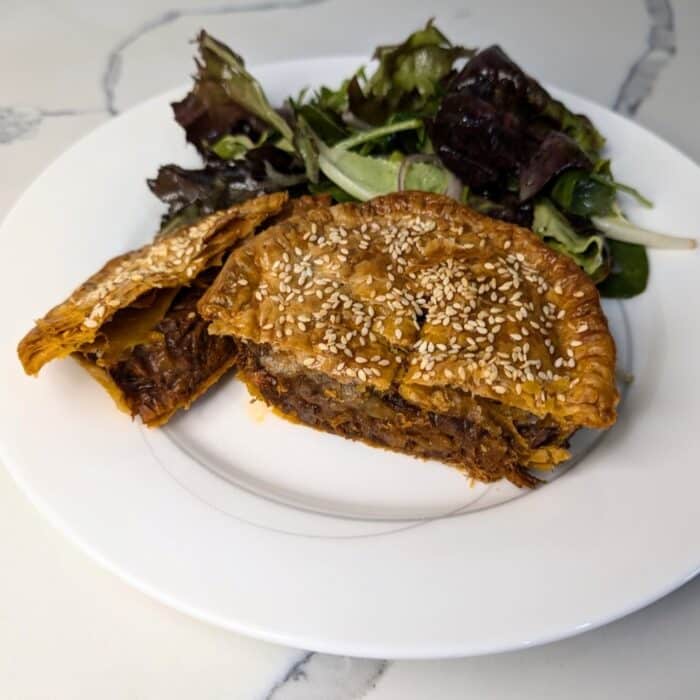
I suggest pairing the wine based on the pie filling you choose. However, I’ve suggested a few staples that should be good with any filling. That includes Chardonnay, Merlot or Cabernet Sauvignon.

Easy Recipes & Perfect Wine Pairings | Cook + Wine

Servings
4 Servings

PREP TIME
60 mins

COOK TIME
60 mins

TOTAL TIME
2 hours

Difficulty
Intermediate

Wine pairing
Cabernet blend, Chardonnay, Merlot
My personal favourite! Whenever I make duck ragu, I always freeze a few cups’ worth to make pies with later.
Tip: For a cheesy twist, add some grated gruyere or grana padano to the top of the filling before encasing it with the puff pastry top.
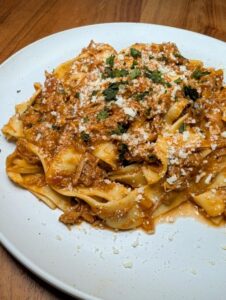
This is another favourite, BUT be conscious that the chowder requires a little extra thickening to be a suitable pie filing.
Note: Seafood chowder pies are best made with fresh chowder (not frozen), due to the presence of seafood.
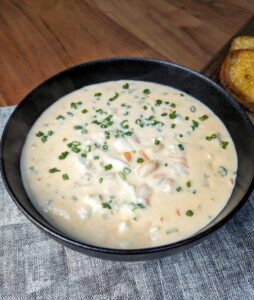
A classic pie filling! Make sure you scoop out the thicker/less watery leftovers for pie filling; use a slotted spoon or sieve to get the best outcome.
Another tip is to smother the bolognese filling with tasty cheese or parmesan before adding the puff pastry top.
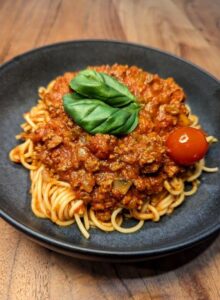
If bolognese is good, beef ragu is better! Cheese topping is optional, but encouraged.
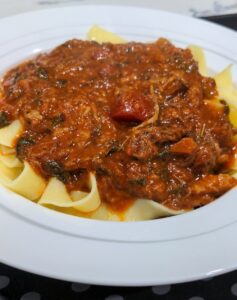
There’s rarely leftovers when I make stroganoff in my house, but on the odd chance there is, it’s delicious as a pie filling!
If you like your stroganoff topped with a dollop of sour cream, smear a teaspoon or two on top of the filling before you add the puff pastry top. It’ll give the whole pie an extra hint of creaminess.
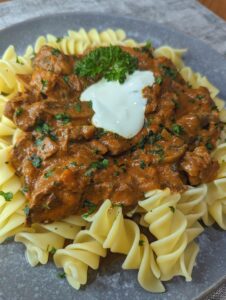
Beef cheeks and pie is a match made in heaven! But, you will want to thicken the red wine sauce so it doesn’t run straight out of your pie after you take a bite!
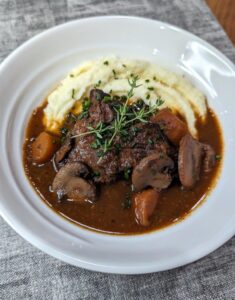
1. Remove your shortcrust pastry/pie crust from the fridge and set aside (covered with a tea towel) for about 15 minutes so it warms a little.
2. Pre-heat the oven to 180°C / 350°F fan-forced (200°C / 375°F conventional), and lightly grease or spray oil your pie dishes/tins.
3. Cut the pie bases from the pastry: place something about 1 inch larger than than the pie dishes on top of the pastry (for example, I use a cereal bowl). Run a knife around the bowl to cut your bases.
Tip: You may need to press sheets of the pastry together to form a larger sheet, or use the off-cuts so you have enough to cut all the bases. When the pastry is at room temperature, you can simply overlap the sheets slightly and press them together with your fingertips until they seal.
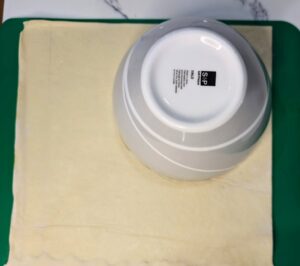
4. Set the leftover pastry aside and cover it with a tea towel (it’s needed later on).
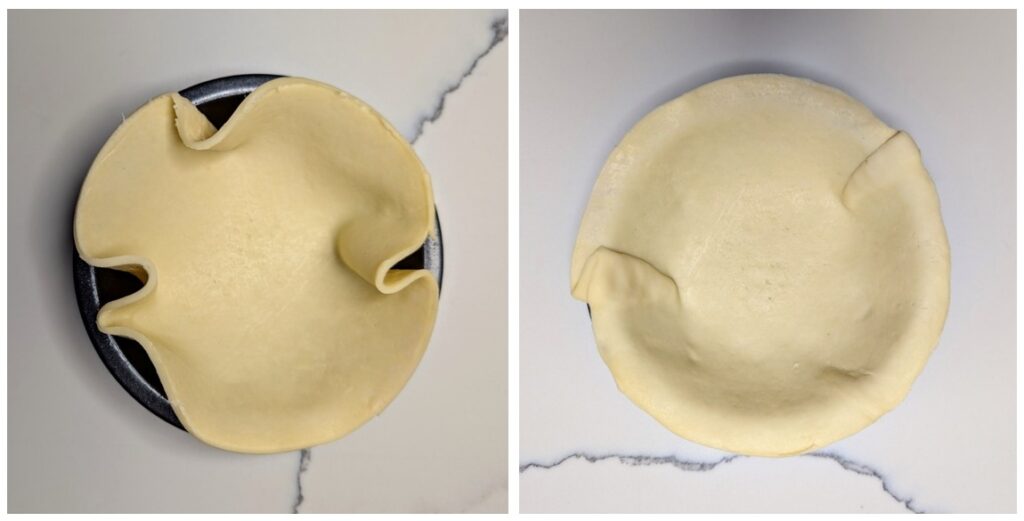
5. Place the pastry bases in the pie dishes: this gets easier with practice!
Tip: Don’t worry about appearance or evenness at this stage; the pastry is going to shrink during cooking, and this is just the first step.
6. Place a small sheet of baking paper or foil in the centre of each pie dish, and fill each at least halfway with pie weights, or rice.
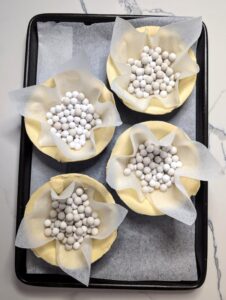
7. Place the pie dishes on a lined baking tray, and place in the oven for 10-15 minutes. Meanwhile, whisk the egg in a small bowl and set aside.
8. Remove the tray from the oven, and remove the pie weights or rice and the baking paper or foil. If there are any holes or thin parts of the pie base, use the leftover pastry to patch them.
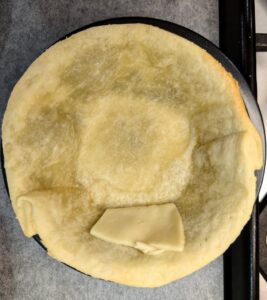
9. Brush the pastry bases with the whisked egg (set the remaining egg aside for the next step).
Tip: This helps to create a liquid-proof base for the pie filling, so the pies hold their shape and don’t break apart while you’re eating them. Depending on the filling, you can also add a thin layer of breadcrumbs over the bottom or a thin layer of cheese to create an additional barrier (both optional).
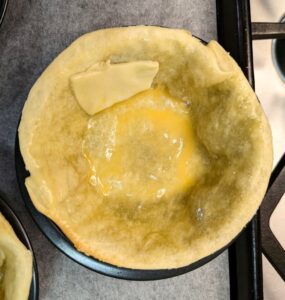
10. Return the tray to the oven for a further 5 minutes.
1. While the pies are in the oven, cut the pie tops from the puff pastry.
Tip: Use another pie tin as a guide to cut the tops the exact right size. Alternatively, a little bigger is better than a little smaller, since pastry shrinks in the oven.
2. Remove the pies from the oven, and fill with your chosen filling (it can be cold or at room temperature, but I wouldn’t recommend super hot since it’s going to cook further in the oven).
Tips:
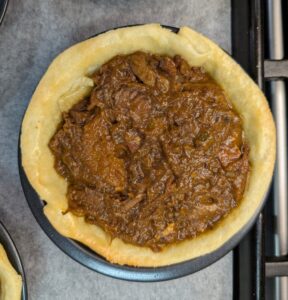
3. Brush the whisked egg on the side of the pastry base, one pie at a time (because it dries fast). Then, place a puff pastry top on top and use a fork to push down all around the sides.
Tip: It may not feel like the fork is sealing the top properly, but they will stick during cooking.
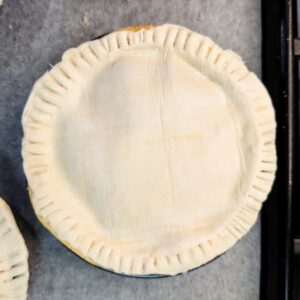
4. Repeat until all pies have tops. Then, cut at least 4 vents into the tops of the pies to release air during cooking (otherwise the pies may burst).
5. Brush the egg over the top of the pastry, then sprinkle with sesame seeds.
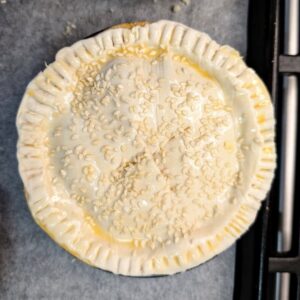
6. Return the pies to the oven for 1 hour, or until the tops are deep golden brown.
Tip: You want the tops to be a deep brown, not just slightly golden.
7. Remove the pies from the oven and allow to cool in the pie dishes for 5-10 minutes.
8. Remove the pies from the pie dishes (they should release easily with a butter knife or fork), and set aside for another 5-10 minutes before eating, because they’ll be hot!
Tip: These actually reheat surprisingly well; store cooked pies in the refrigerator, and place them back inside the pie dish to re-heat in the oven. They don’t overcook from reheating, either! So I make a batch of pies on the weekend to re-heat throughout the week.